The quick answer
No side access doesn't mean no stump removal
Most of the stumps people assume can't be reached can be. Stump removal without side access comes down to matching the machine to the route.
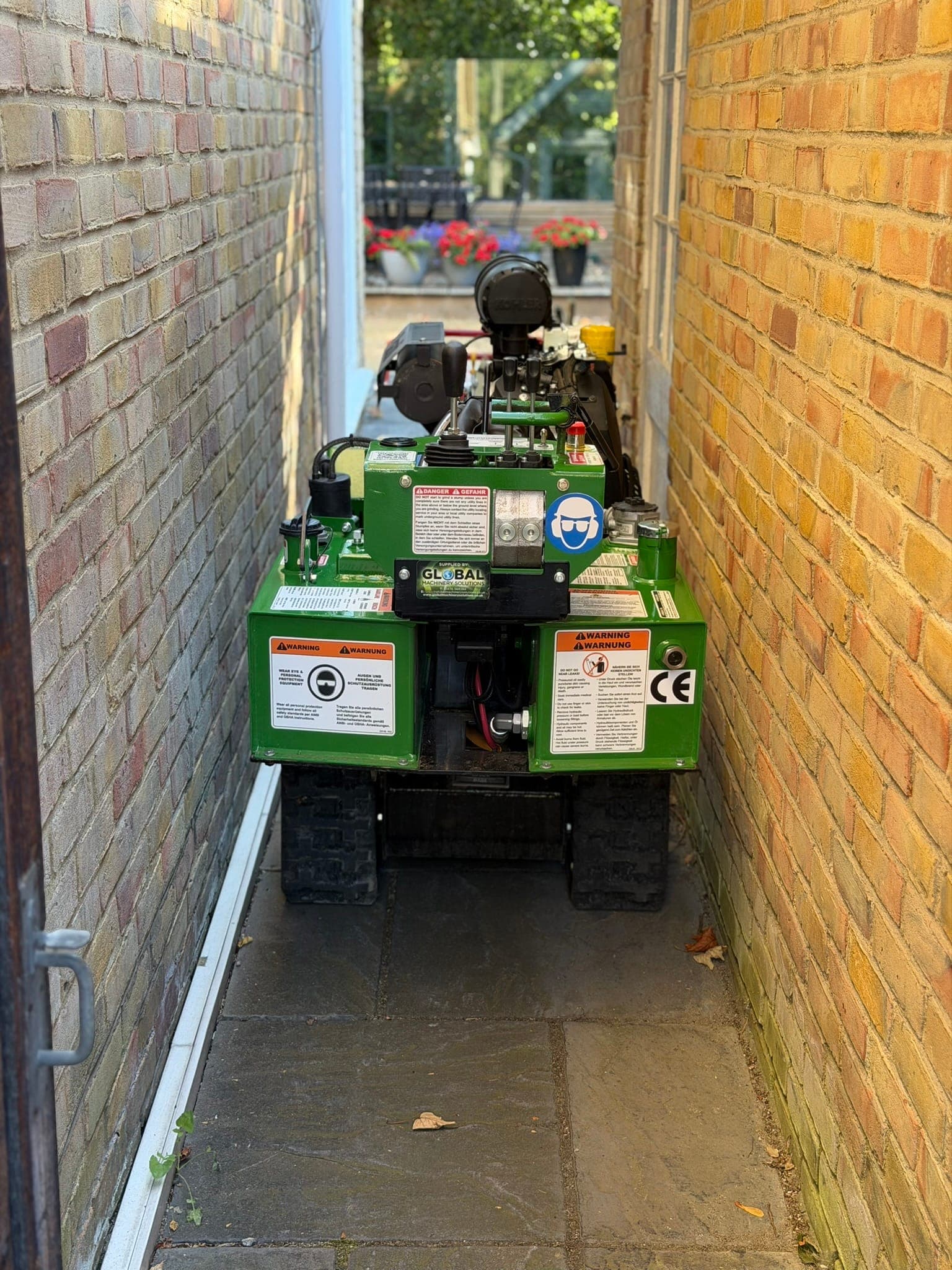
Our Bandit SG-40 is approximately 74cm wide and can get through many narrow gates and passageways, provided there's enough clearance along the entire route. If the only way in is through the house, the Bandit can sometimes go through with care and preparation. Where even that isn't possible, the Terminator chainsaw stump grinder attachment can be carried in by hand.
The question isn't really “can it be done?” It's “which machine, and which route?”
The problem
Why restricted access makes stump removal difficult
Getting a stump grinder into a rear garden can sometimes be more challenging than removing the stump itself.
Narrow gates, passageways, steps and changes in ground level can all restrict access. Some properties, particularly terraced houses, have no external access to the rear garden at all.
A typical restricted-access job might involve one or more of these challenges:
- A side gate or alley narrower than the machine.
- A passageway restricted by downpipes, utility meters or other obstacles.
- No external access, meaning the only route to the rear garden is through the house.
- Changes in ground level, such as walls, steps or raised patios.
- A stump positioned directly against a fence, wall, shed or other structure.
None of these challenges necessarily make stump removal impossible. The key is finding a safe, practical way to reach the stump with the right equipment while protecting the surrounding property.
Restricted access can affect the equipment required, the preparation involved and the time needed to complete the work. That's why we assess the entire access route before providing a quotation.
Measurements
How much clearance does a stump grinder need?
The amount of clearance required depends on the stump grinder being used and the access route to the stump. Narrow gates, passageways and obstacles can prevent some machines from reaching rear gardens, making equipment selection particularly important.
Our main machine, the Bandit SG-40, is approximately 74cm wide, allowing it to access many narrow garden gates and passageways. However, the machine's width alone doesn't determine whether it can get through. Additional clearance may be needed for manoeuvring, particularly around corners, through doorways or where obstacles restrict the route.
Measure the narrowest point of the entire route, from the road to the stump, including anything that protrudes from walls, such as gate hinges, downpipes and utility boxes. A photograph showing a tape measure across the tightest gap is particularly useful when assessing access.
Narrow access stump grinding
Taking the Bandit SG-40 through narrow passages and gates
The SG-40 is a tracked machine, so it can crawl down a long, narrow passage at walking pace and still have the weight and power to deal with a large stump once it arrives. For most narrow access stump grinding, this is the machine we want to use, because it gets through a stump far quicker than handheld equipment.
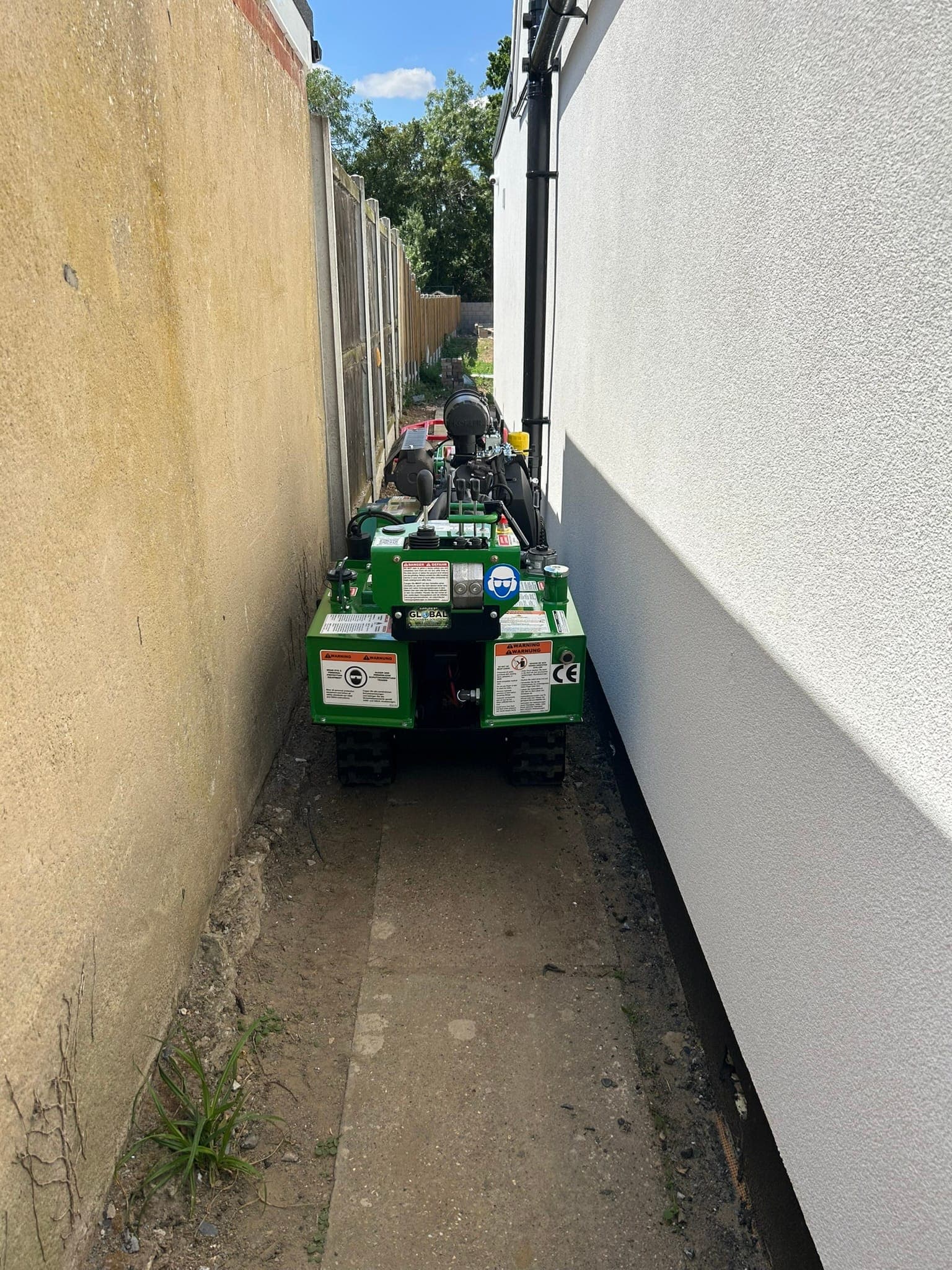
Tight passages are taken slowly and carefully, often with someone guiding from the front. Where the route crosses paving, lawn or a threshold, we lay boards or mats so the tracks don't mark the surface. You can see more of this kind of work on our tight access stump grinding page and in our Loughton tight access project.
Stump grinder through house
When the only way in is through the house
Mid-terrace houses are the classic case: no side gate, no rear alley, and a garden that can only be reached through the front door, hallway and kitchen. It's more common than people think, and it's something we're regularly asked about.
Whether a stump grinder can go through a house depends on the narrowest doorway, the turns in the hallway, any steps, and what the floors are made of. Sometimes the Bandit will fit. Sometimes it'll fit once a door is taken off its hinges or a door frame is temporarily removed. And sometimes the hallway simply won't allow it, which is where the Terminator comes in.
Before taking a tracked machine indoors, we assess the whole route carefully. That includes:
- Floor surfaces: laminate, tiles, carpet and solid wood each need different protection, and some are more easily marked or cracked than others.
- Load-bearing suitability: whether the floors along the route can safely take the weight of the machine, particularly suspended timber floors.
- Doorway dimensions: the clear width of every doorway, measured with doors open and allowing for frames, handles and stops.
- Turning space: whether there's room to manoeuvre at corners, at the foot of stairs and between rooms.
- Thresholds: raised sills, steps and changes in floor level that need bridging with boards or ramps.
- Property protection: plywood boards, rubber matting and coverings for walls and door frames, chosen to suit the route.
If any part of the route isn't suitable, we'll tell you and recommend another approach rather than take the risk.
Real example: a large sycamore stump in Ilford
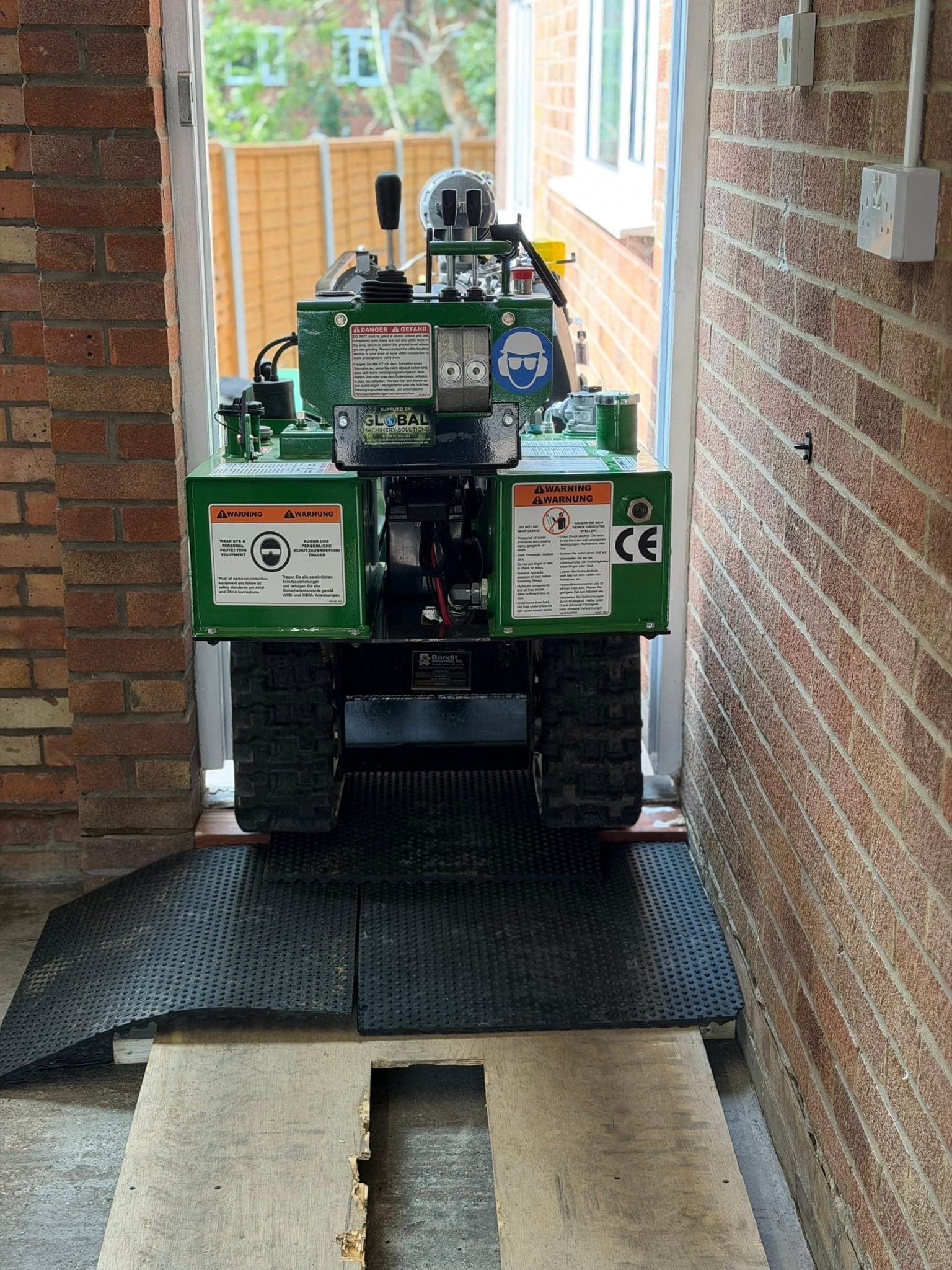
In Ilford, a large sycamore stump needed to come out to make way for a new garden room. The property had no side access, so the Bandit SG-40 was taken through the house after the door frames had been removed.
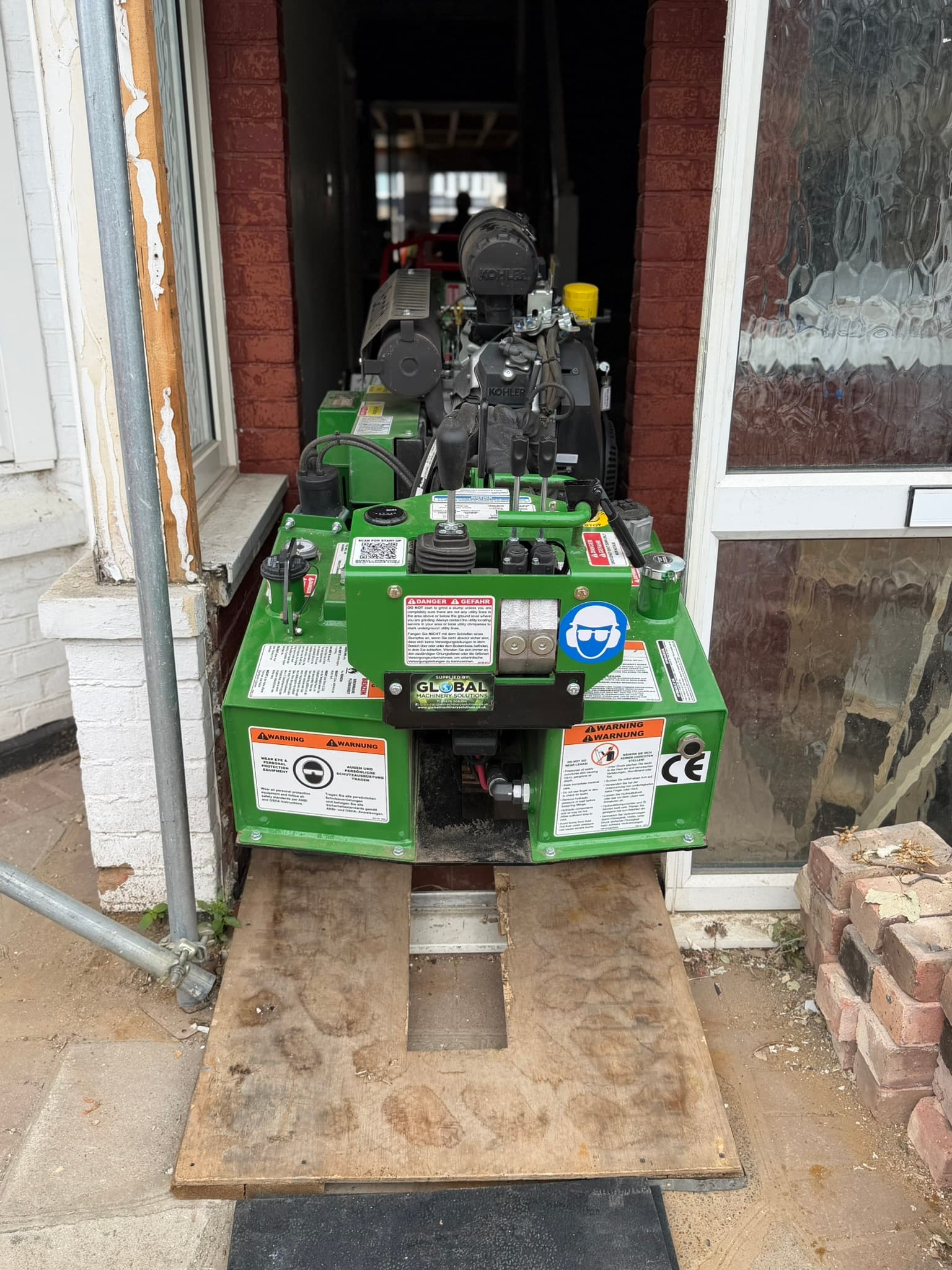
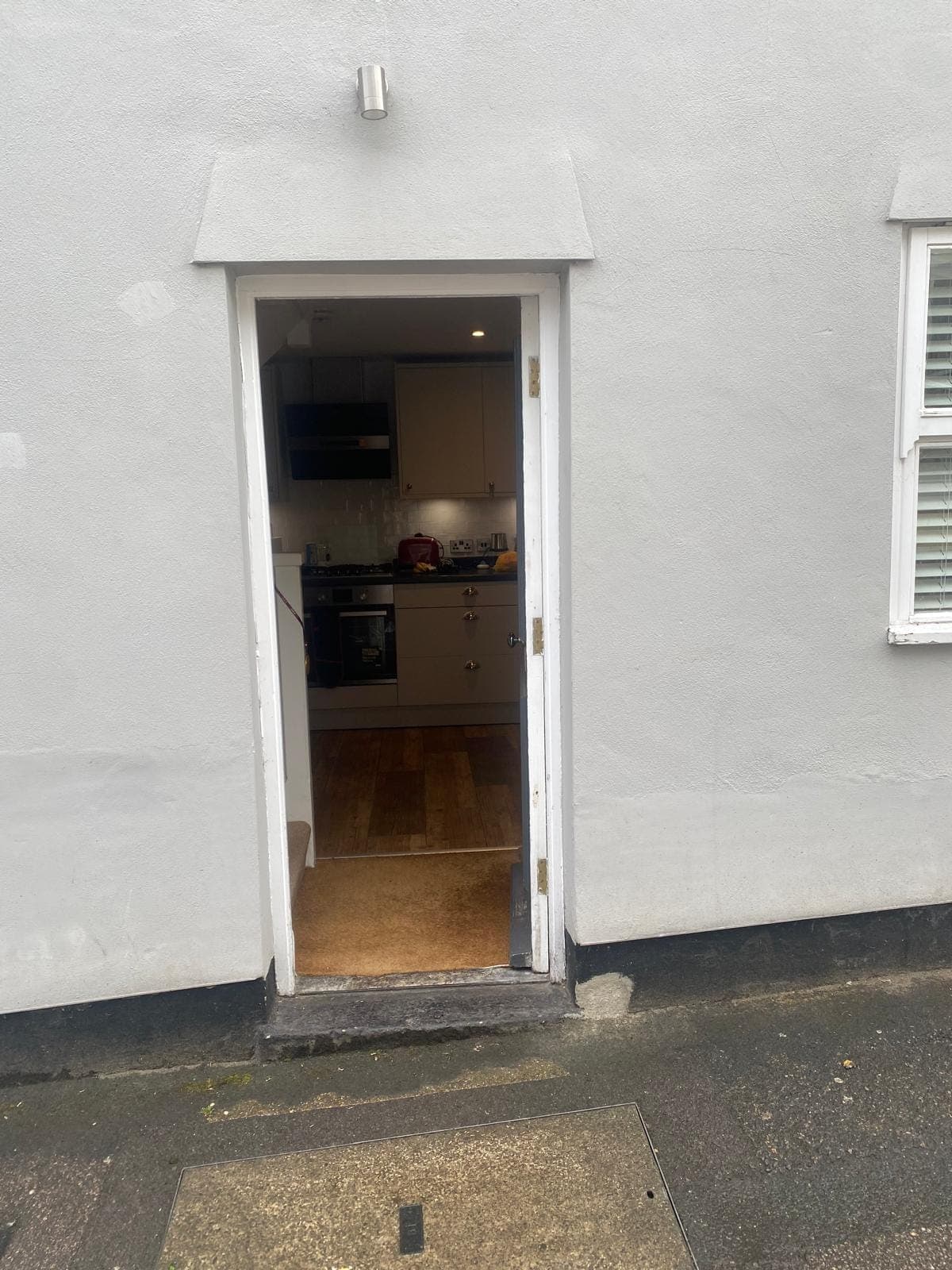
Getting through the house was only part of it, as you'll see in the next section. The full story is in our Ilford sycamore stump removal project.
Planning the route
Temporary ramps and protecting the property
Routes into rear gardens are rarely flat. There may be a step down from the back door, a raised patio, or, as in Ilford, a wall between the house and the garden. When that happens we build a temporary route using loading ramps and heavy timber so the machine can climb over safely and under control.
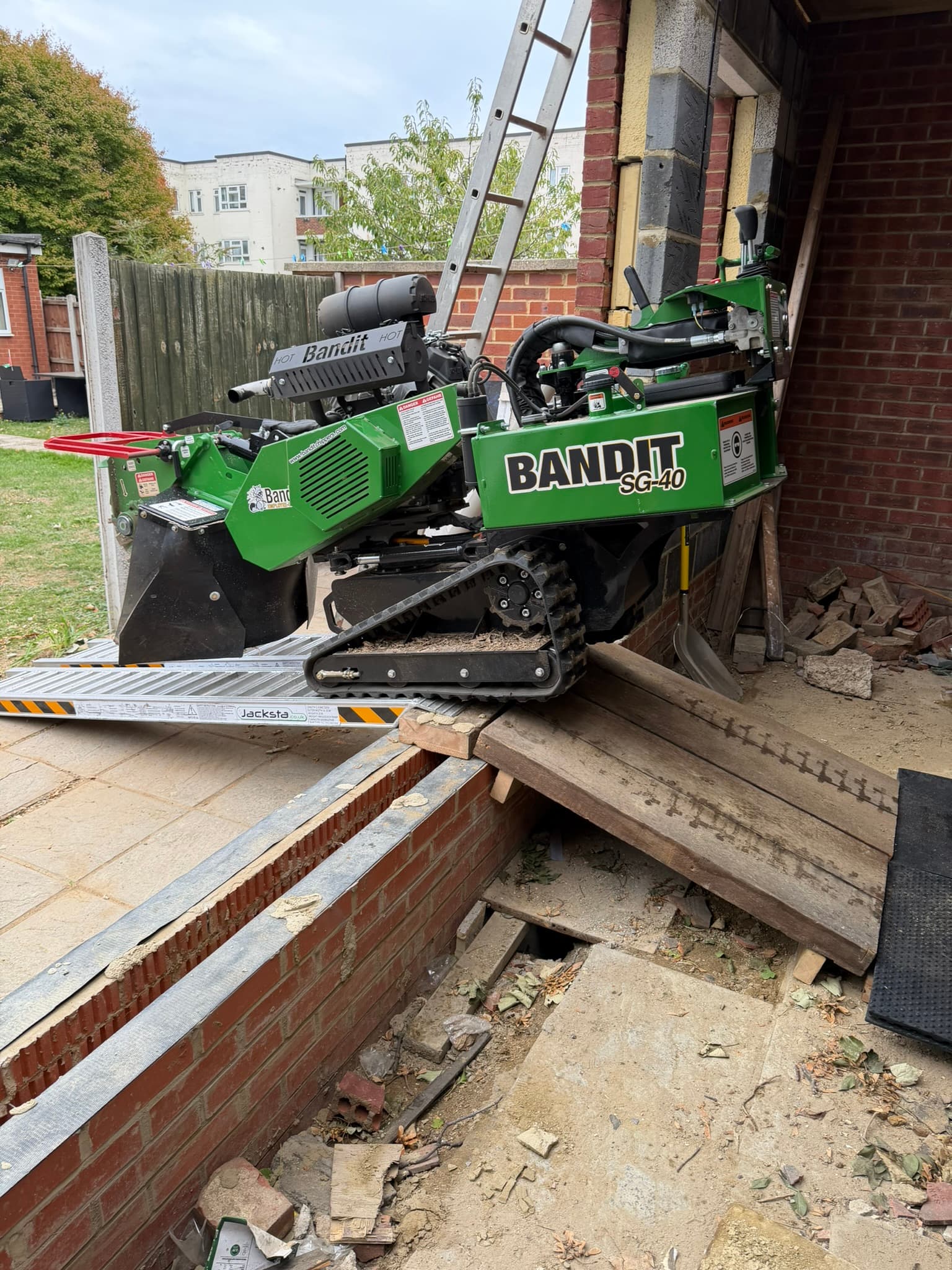
Where it's needed, protection on the way through can include:
- plywood boards over thresholds and floors
- rubber matting across paving, decking and lawns
- timber packing to bridge steps and level changes
- removing doors or frames beforehand, by agreement
We agree the route and any preparation with you before the day, so there are no surprises.
Tight access stump grinder
The Terminator, for extremely restricted access
When the Bandit can't get there, the Terminator usually can. It's a stump grinding attachment that bolts onto a powerful chainsaw, replacing the bar and chain with a small cutting wheel, guard and a single transport wheel. It can be carried through a house, up steps or through a garden gate by hand.
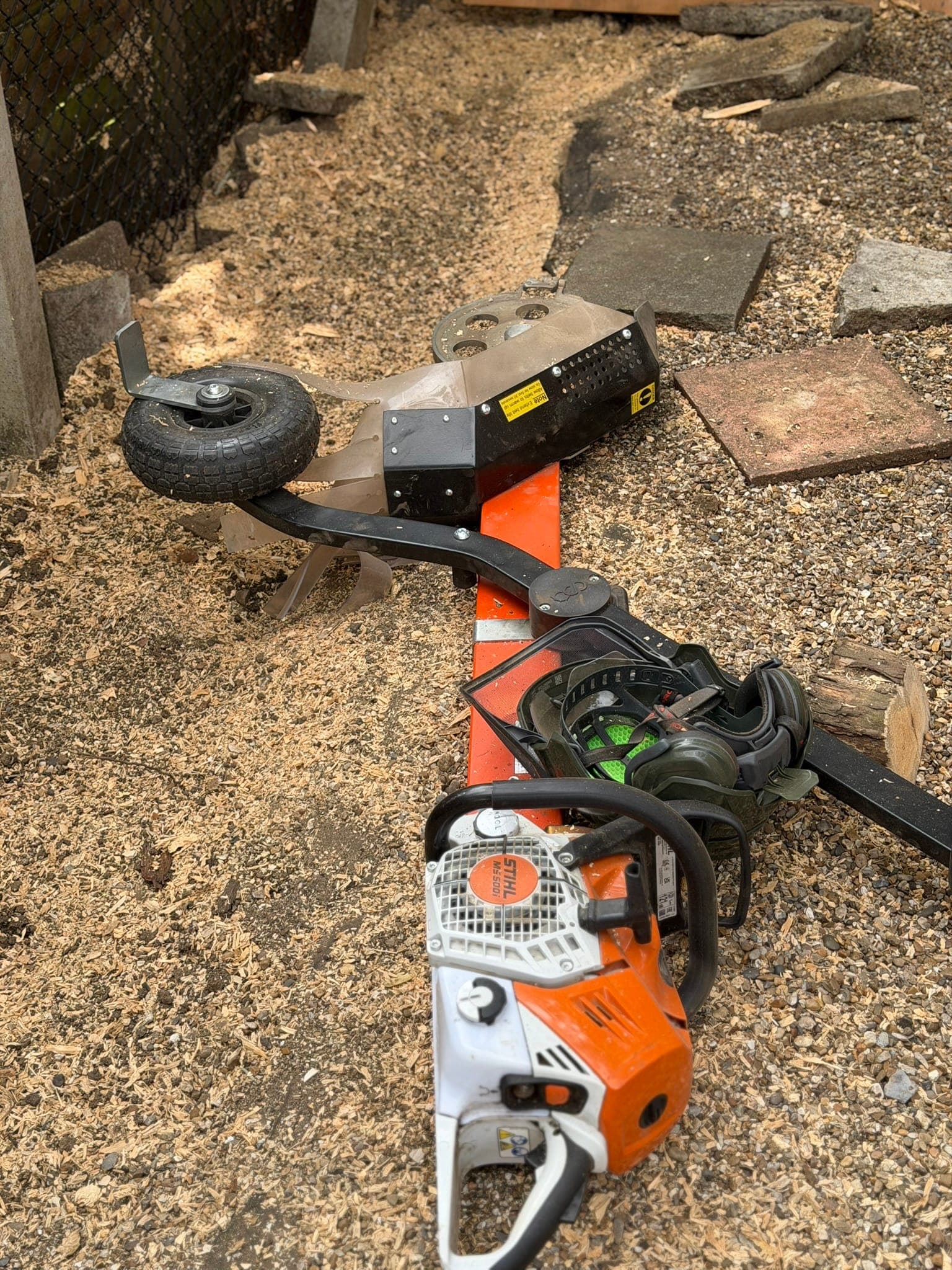
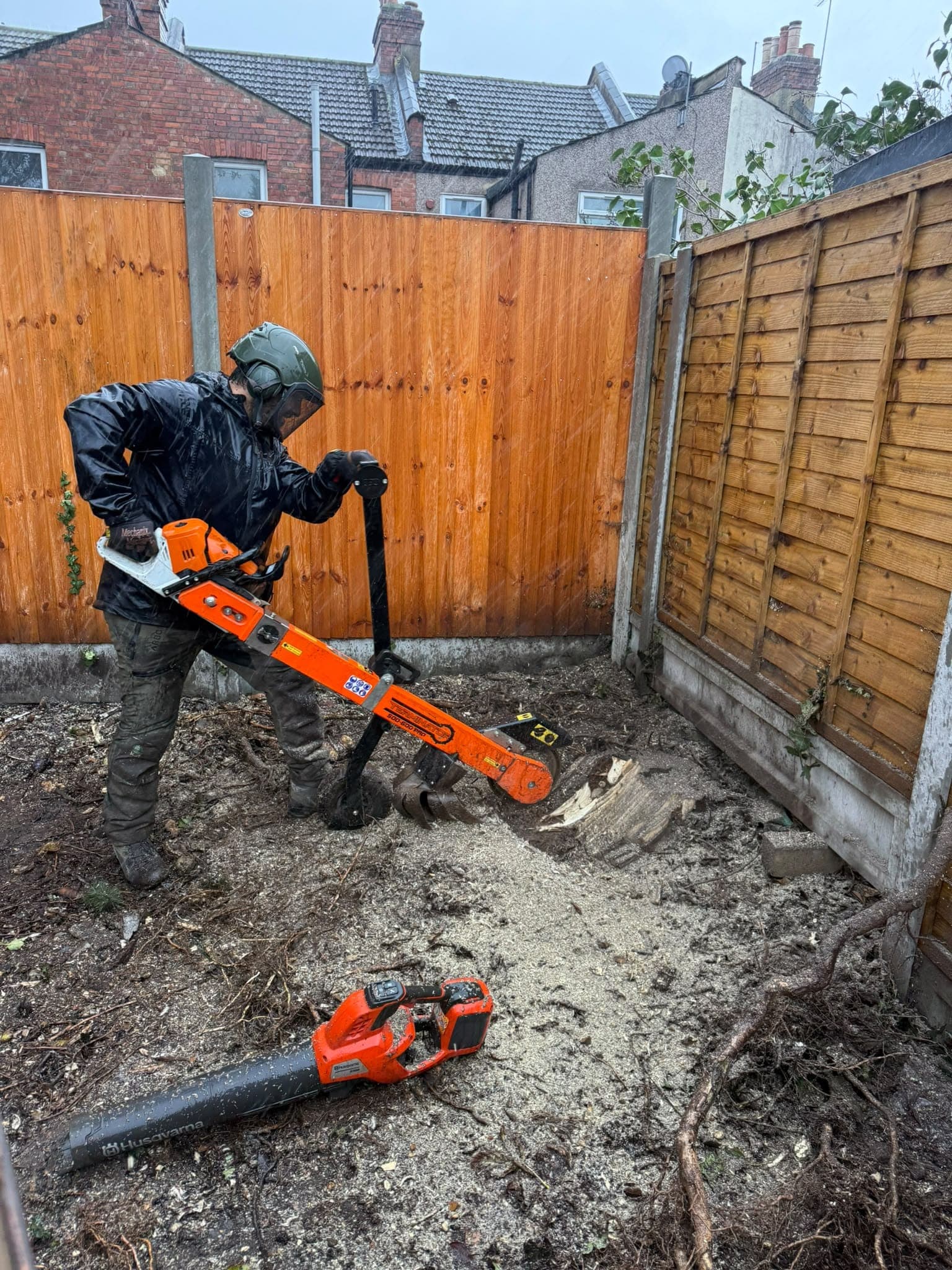
The trade-off is speed. It removes less wood per pass than a tracked grinder, so a large stump takes longer. For many enclosed gardens, though, it's the difference between the stump being ground out and it staying where it is.
It's far from a last resort. Approximately 40% of our stump grinding jobs involve the Terminator, whether for restricted access, precision work close to fences and structures, or alongside larger machines when a job calls for both.
Real example: a mid-terrace garden in Bishop's Stortford
At a mid-terrace property in Bishop's Stortford, restricted access meant the stump was removed using the Terminator attachment rather than a tracked machine.
The Terminator is also useful alongside the Bandit. In Ilford, the sycamore stump had embedded metal in it. That needed extra work with the Terminator and an angle grinder before the stump could be fully dealt with.
Tight spots
Removing stumps close to walls, fences and structures
Stumps in restricted gardens are very often right up against something: a fence line, a concrete gravel board, a garden wall or the footings of a shed. Trees planted along boundaries tend to stay there.
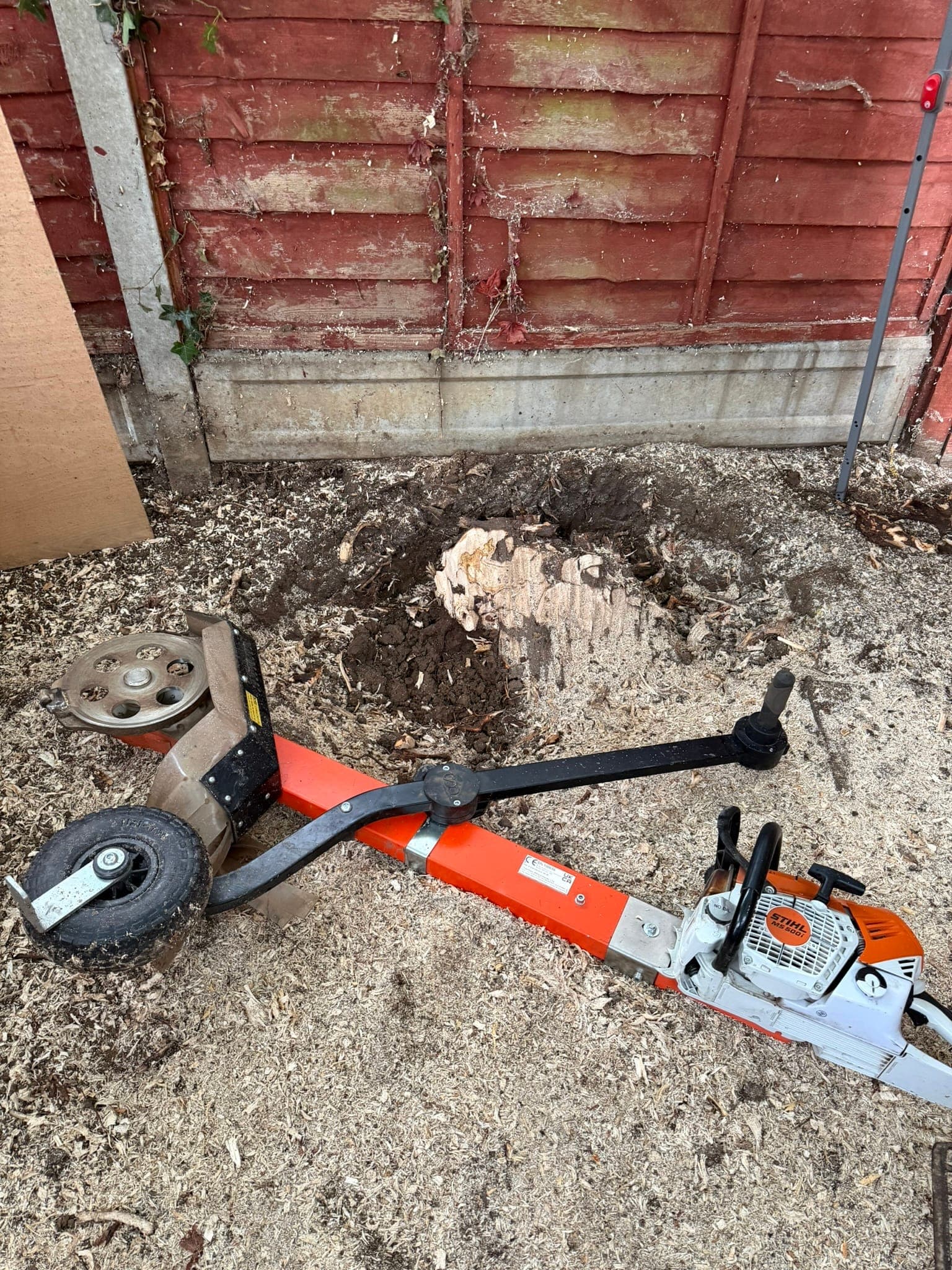
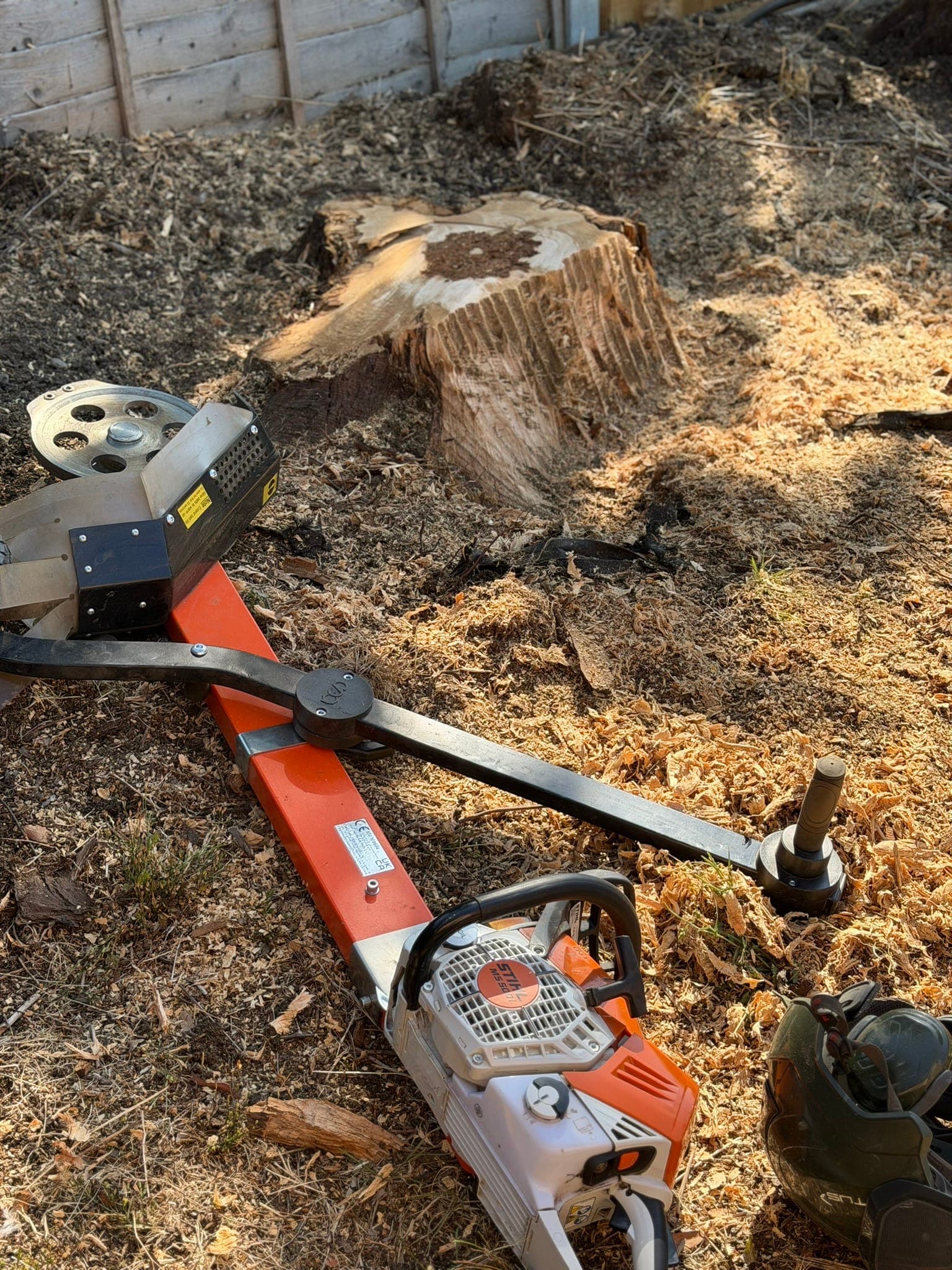
Close to structures, we grind carefully and work around fence posts, gravel boards and foundations rather than through them. We'll be honest if part of a stump or root can't be safely ground without damaging what's next to it. Photos showing how close the stump is to anything nearby help us tell you that up front.
The finish
How deep is the stump ground?
Restricted access doesn't change the standard finish. We grind stumps to approximately 8″ (20cm) below ground level, which is enough for turf, topsoil and most planting.
If you're building over the area, laying a base for a garden room, or need roots chased out further, deeper grinding or fuller removal can be done where it's required and practical. Let us know what's going in afterwards and we'll plan for it.
Pricing
How restricted access affects stump removal costs
The stump itself still drives most of the price: its diameter, the species and the ground around it. Access adds to that in a few practical ways:
- Slower equipment. When the Terminator is needed instead of the Bandit, the same stump takes longer to grind.
- Preparation. Laying protection, building ramps or working through a house all take time before grinding starts.
- Moving chippings. If waste has to come back out through the house or a long passage, that takes time too.
Our instant quote calculator lets you choose restricted access, and uses its own calibration for it. For the full breakdown, read how much stump grinding costs and how long it takes.
Getting a quote
What photos and measurements to send us
For restricted access stump removal, the access route matters as much as the stump. The more of it we can see, the more accurate your quote will be.
The stump
Close up, plus a wider shot showing what is around it.
Stump diameter
Measured across the widest part, at about ground level.
The narrowest point
A photo with a tape measure across the tightest gap.
The whole route
From the road to the stump: gates, passages or hallway.
Steps and levels
Any steps, walls, patios or slopes along the way.
Your postcode
So we can confirm we cover your area.
We cover Essex, Hertfordshire and East London. See all the areas we cover.
No side access?
Send us photos of your stump and the route to it, and we'll tell you how we can reach it.
Include the stump, its diameter, the narrowest point of the access route and your postcode.