The quick answer
Two numbers, not one
The single most important thing to understand is that “how long stump grinding takes” has two answers, and they are very different.
Grinding time
The predicted time the stump grinder is actually cutting the stump.
Time on site
The total estimated visit — setup, preparation, grinding, repositioning, clearing and loading.
For a straightforward Standard Access stump at our 2000 N baseline, predicted machine grinding times are approximately:
| Stump diameter | Approx. grinding time |
|---|---|
| 30cm | 4 minutes |
| 50cm | 9 minutes |
| 60cm | 12 minutes |
| 75cm | 18 minutes |
| 100cm | 30 minutes |
| 125cm | 45 minutes |
| 150cm | 61 minutes |
These are approximate machine grinding times under our baseline model — not total time on site, and before any adjustment for species or site conditions.
A stump that takes 10 minutes to grind is not a 10-minute visit.
The big picture
What actually determines how long it takes?
There is no single answer to how long stump grinding takes. Rather than dropping every stump into a broad “small, medium or large” band, our calculator estimates the actual work from five factors: stump diameter, tree species, access, site conditions and the number of stumps.
- Stump diameter
- Baseline grinding time
- Tree species adjustment
- Access / equipment
- Predicted grinding time
- Site conditions
- Productive working time
- Setup / load allowance
- Estimated time on site
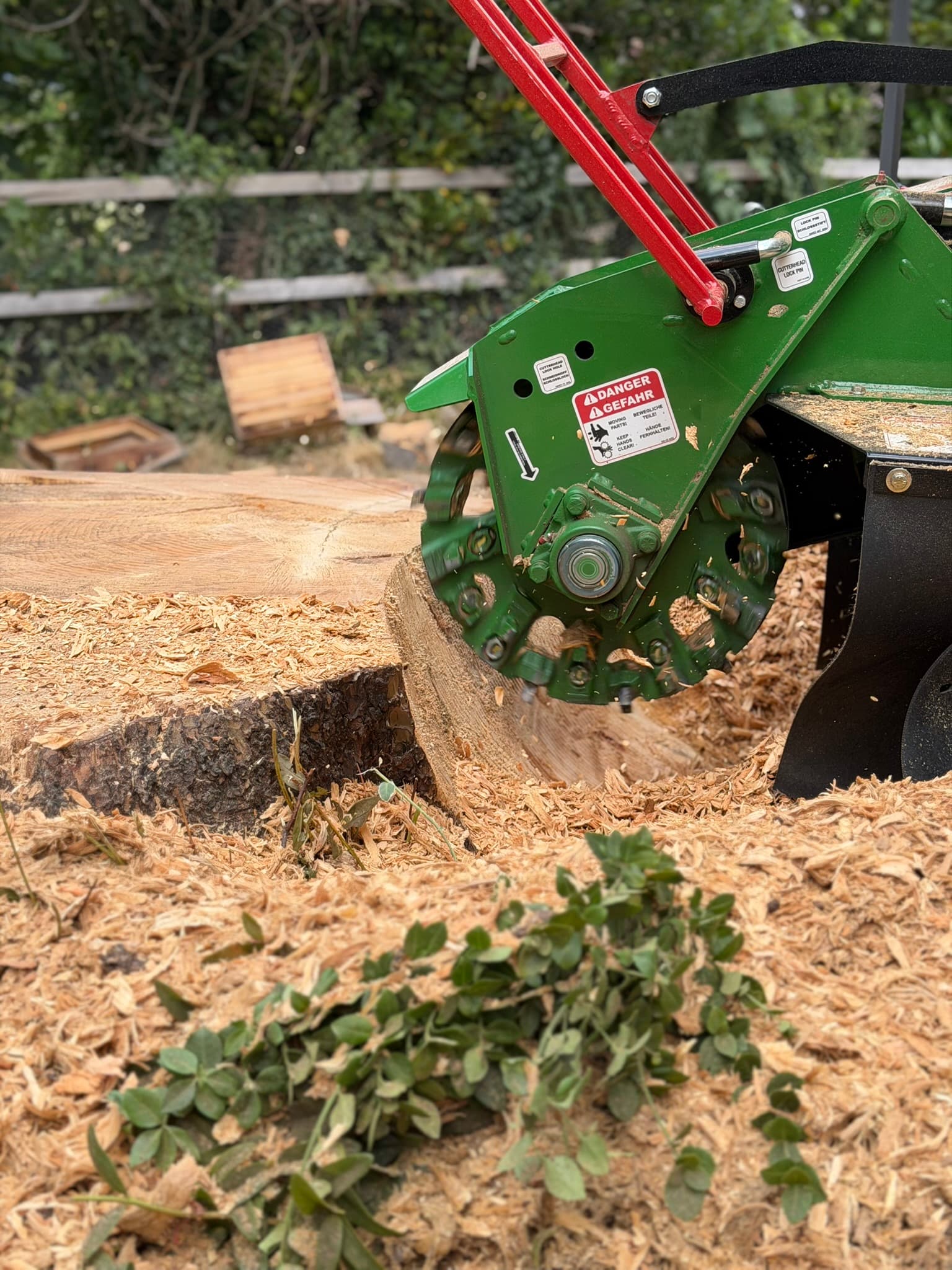
Factor 1
Stump diameter
Diameter is the main starting point. Measure across the widest part of the stump, at roughly ground level. The calculator accepts centimetres or inches (1 inch = 2.54cm).
Crucially, grinding time does not increase in a straight line with diameter. Our current Standard Access baseline model is:
Standard Access baseline (grinding minutes)
Where T is the predicted grinding time in minutes and D is the stump diameter in centimetres. Before any species adjustment, this produces:
| Diameter | Grinding time |
|---|---|
| 30cm | ≈ 3.6 minutes |
| 50cm | ≈ 8.9 minutes |
| 60cm | ≈ 12.2 minutes |
| 75cm | ≈ 18.1 minutes |
| 100cm | exactly 30 minutes |
| 125cm | ≈ 44.5 minutes |
| 150cm | ≈ 61.3 minutes |
Minutes (vertical) against stump diameter in cm (horizontal), using the model values.
Why does grinding time increase so quickly?
A common assumption is: “if a 50cm stump takes 10 minutes, a 100cm stump should take 20 minutes.” Our model does not work like that. A wider stump contains far more material across the grinding area, and the cutting wheel has to work through a much greater volume of stump and root flare.
Doubling the diameter does not simply double the grinding work.
50cm baseline
≈ 8.9 min
100cm baseline
30 min
150cm baseline
≈ 61 min
Why the exponent is 1.7601
For readers who want the technical explanation: our diameter/time curve was derived from published stump-grinder performance benchmark data — approximately:
300mm stump
3.5 min
600mm stump
9 min
1000mm stump
30 min
A power-law fit to those benchmark points produced an exponent of approximately 1.7601, giving the curve T = 30 × (D / 100)1.7601. Be clear that this is a model: it gives us a rational starting relationship between diameter and grinding time, not a claim that every stump of a given diameter takes exactly that many minutes. Real-world job data can later be used to recalibrate it.
Factor 2
Tree species
Stump diameter alone cannot determine grinding time — two 50cm stumps can behave differently depending on the wood. The calculator adjusts predicted grinding time for species, using Janka hardness as a practical proxy.
We're transparent about this: Janka hardness measures resistance to indentation. It is not a direct measurement of stump-grinder cutting resistance. Actual cutting performance is also affected by density, moisture, grain, decay, root structure, soil contamination and cutter condition. But Janka gives us a repeatable way to distinguish softer woods from harder species.
Species factor
Where J is the species' Janka value and 2000 N is our reference baseline.
Why use the square root?
We deliberately dampen the effect of hardness. If one species has twice the Janka hardness, we do not assume it automatically takes twice as long to grind. Taking the square root creates a more moderate adjustment.
Leylandii baseline
Leylandii working value: 2000 N.
√(2000 / 2000) = 1.00
Leylandii therefore receives no adjustment.
Unknown / Not sure
Most customers won't know the species. Working value: 3000 N.
√(3000 / 2000) = 1.2247
About 22.5% more predicted grinding time — a modest uncertainty allowance, not an assumption that it's an extremely hard species.
Species examples
The full calculator contains a much broader species database. These are working estimation inputs — they do not imply Janka hardness perfectly predicts grinding performance:
| Species | Janka (N) | Species factor |
|---|---|---|
| Leylandii | 2000 | ×1.00 |
| Sweet Chestnut | 3000 | ×1.22 |
| Oak | 4980 | ×1.58 |
| Silver Birch | 5360 | ×1.64 |
| Ash | 5900 | ×1.72 |
| Beech | 6460 | ×1.80 |
| Yew | 6760 | ×1.84 |
| Hawthorn | 7000 | ×1.87 |
| Hornbeam | 7500 | ×1.94 |
Same size, different species
Take a 50cm stump. The baseline grinding time is:
Apply the species factor and the same diameter gives different times:
50cm Leylandii
≈ 8.9 min
× 1.00
50cm Unknown
≈ 10.9 min
× 1.2247
Same diameter. Different predicted grinding time.
Factor 3
Access can change everything
Access does more than decide whether the machine physically fits — it can determine which grinding equipment we can use, and different equipment has different productivity.
Standard access
75cm or wider, and not through the house.
T = 30 × (D / 100)1.7601
Restricted access
Under 75cm wide, or access through the house.
T = 10 × (D / 35.56)1.7601
Calibrated to about 10 grinding minutes for a 14-inch (35.56cm) stump — a separate model rather than an arbitrary percentage added on top.
This is why two identical stumps can have very different estimated completion times depending on access.
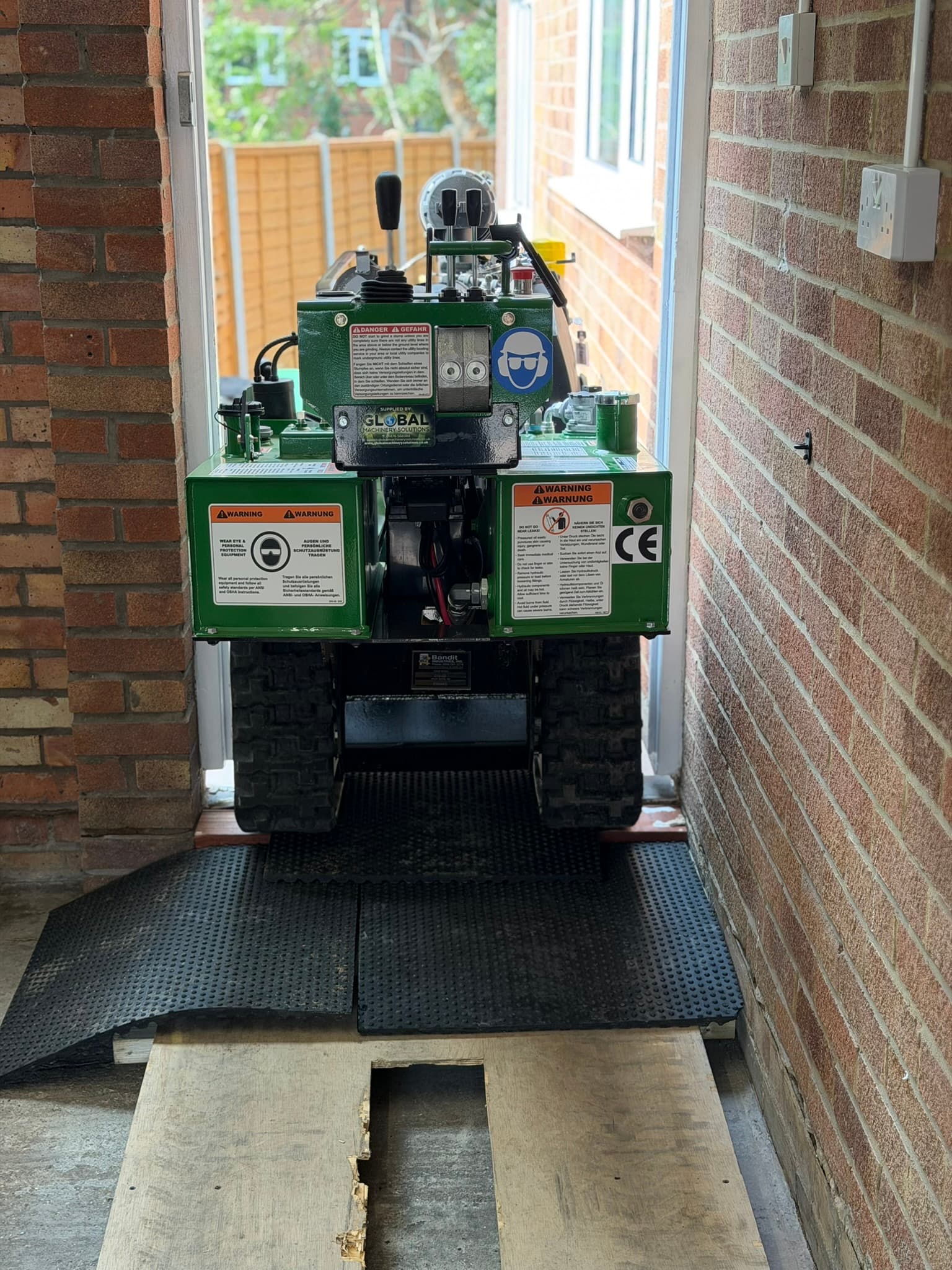
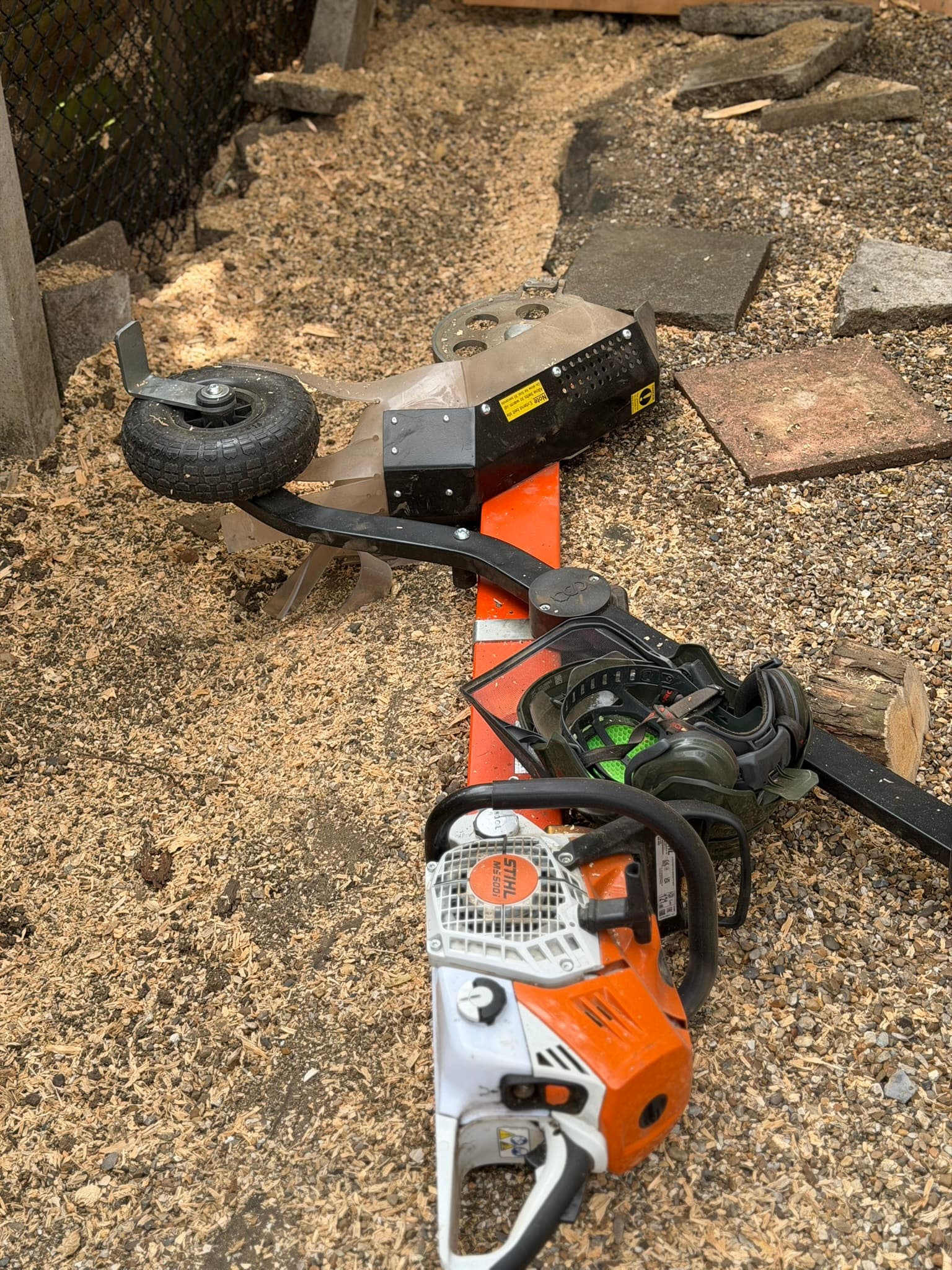
You can see restricted access in practice in our tight-access stump grinding work.
The key distinction
Grinding time is not working time
If the calculator predicts 30 minutes of grinding, that does not mean we spend only 30 minutes on the job. Grinding time is specifically the predicted time the grinding equipment is cutting the stump. Productive work also includes plenty that happens with the wheel switched off:
- Getting equipment into position
- Reducing / preparing the stump
- Exposing roots or stump edges
- Digging around obstructions
- Moving protection boards
- Repositioning the grinder
- Dealing with stones
- Working close to walls and fences
- Working around paving
- Chainsaw preparation
- Raking grindings
- Tidying the work area
The grinding wheel does not need to be spinning for work to be taking place.
Factor 4
Site conditions
The calculator has three site-condition categories. These multipliers convert predicted grinding time into predicted productive operator time.
| Condition | Meaning | × |
|---|---|---|
| Normal | Clear working area, no significant obstacles | ×1.50 |
| Difficult | Rocks, paving, walls/fences or extra preparation | ×1.75 |
| Very difficult | Heavy obstructions or substantial digging/preparation | ×2.00 |
Applied to 30 minutes of grinding time:
Normal
45 min
30 × 1.50
Difficult
52.5 min
30 × 1.75
Very difficult
60 min
30 × 2.00
This is productive operator time — which is why two identical stumps can have different total job times.
Factor 5
From working time to total time on site
Our site-time estimation model adds a fixed allowance, then rounds up:
Estimated site time
Where T is total predicted grinding minutes, C is the site-condition multiplier, and 20 is a fixed setup/load allowance in minutes. Then we round up to the next 15-minute block:
Why add 20 minutes?
The 20 minutes is a fixed scheduling allowance for the visit. Even if a stump only takes a few minutes to physically grind, the machine still has to be unloaded, moved into position and loaded again. This is why 10 grinding minutes does not mean 10 minutes on site. It's used for time estimation and scheduling, not as an additional customer charge.
Why round up to 15 minutes?
Displaying “estimated time on site: 53 minutes” would imply a precision that doesn't exist in real stump grinding. Practical scheduling blocks are more honest and more useful:
| 31 minutes | → 45 minutes |
| 45 minutes | → 45 minutes |
| 46 minutes | → 1 hour |
| 61 minutes | → 1 hour 15 minutes |
Putting it together
Complete worked examples
Example 1 — a 50cm stump
50cm, species Unknown / Not sure, Standard access, Normal conditions.
- 1
Baseline grinding time
30 × (0.5)1.7601≈ 8.86 minutes
- 2
Species
Unknown = 3000 N → √(3000 / 2000) = 1.2247
8.86 × 1.2247≈ 10.85 grinding minutes
- 3
Productive operator time
10.85 × 1.50 (Normal)≈ 16.28 minutes
- 4
Setup / load allowance
16.28 + 20≈ 36.28 minutes
- 5
Practical scheduling
Round up to the next 15-minute block: 36.28 → 4545 minutes
Grinding time
≈ 11 min
Wheel actually cutting the stump.
Time on site
≈ 45 min
The whole visit, start to finish.
50cm Unknown · Standard access · Normal conditions
Example 2 — a 100cm stump
100cm, species Leylandii, Standard access, Normal conditions.
- 1
Baseline grinding time
30 × (1.0)1.7601exactly 30 minutes
- 2
Species
Leylandii = 2000 N → √(2000 / 2000) = 1.00
30 × 1.0030 grinding minutes
- 3
Productive operator time
30 × 1.50 (Normal)45 minutes
- 4
Setup / load allowance
20 + 4565 minutes
- 5
Practical scheduling
Round up to the next 15-minute block: 65 → 751 hour 15 minutes
Grinding time
30 min
Wheel actually cutting the stump.
Time on site
1 hr 15 min
The whole visit, start to finish.
100cm Leylandii · Standard access · Normal conditions
Compare the two:
50cm Unknown ≈ 11 grinding minutes and ≈ 45 minutes on site. 100cm Leylandii = 30 grinding minutes and ≈ 1 hour 15 minutes on site. Doubling the diameter roughly trebles the grinding time.
Example 3 — same stump, different conditions
Now take a stump with exactly 30 predicted grinding minutes and change only the site conditions:
| Conditions | Productive work | + 20, rounded up |
|---|---|---|
| Normal | 30 × 1.50 = 45 min | 1 hour 15 minutes |
| Difficult | 30 × 1.75 = 52.5 min | 1 hour 15 minutes |
| Very difficult | 30 × 2.00 = 60 min | 1 hour 30 minutes |
Note how rounding can cause two different raw site-time estimates (65 and 72.5 minutes) to display the same practical scheduling block.
Factor 5
How long do multiple stumps take?
We calculate every stump separately. We never add all the diameters together and treat them as one giant stump — because the diameter/time curve is nonlinear, that would badly overstate the work.
Each stump individually, then summed
Each stump receives its own diameter calculation and species adjustment, and then the grinding times are added together.
Multiple-stump worked example
3 × 50cm Unknown stumps, Standard access, Normal conditions. Each is ≈ 10.85 grinding minutes.
- 1
Total grinding time
10.85 × 3≈ 32.55 minutes
- 2
Productive operator time
32.55 × 1.50 (Normal)≈ 48.83 minutes
- 3
Setup / load allowance
48.83 + 20≈ 68.83 minutes
- 4
Practical scheduling
Round up to the next 15-minute block: 68.83 → 751 hour 15 minutes
Grinding time
≈ 33 min
Wheel actually cutting the stump.
Time on site
1 hr 15 min
The whole visit, start to finish.
3 × 50cm Unknown · Standard access · Normal conditions
Multiple stumps can be completed efficiently in one visit because the fixed setup/load allowance happens once for the job, not once per stump.
Three 50cm stumps vs one 150cm stump
Using baseline 2000 N values to keep it simple:
Three 50cm stumps
≈ 26.6 min
8.86 × 3
One 150cm stump
≈ 61.3 min
single
Same total diameter. Completely different grinding workload.
This is exactly why the calculator asks you to add each stump individually rather than entering one combined measurement.
Good to know
What can make it take longer — or quicker?
Can take longer
- Very large diameter
- Harder tree species
- Restricted or through-house access
- Rocks, paving, walls, fences or concrete
- Buried or old metal / fencing
- Unusual root flare or extensive surface roots
- Substantial preparation or digging
- Underground services
- Deeper-than-standard grinding
Can be quicker
- Smaller stump
- A species that grinds easily
- Wide, direct access
- An open, clear working area
- No rocks or obstructions
- Clear surrounding ground
- Several straightforward stumps in one visit
Does stump height matter?
Our model is based on stump diameter at ground level. We normally reduce the stump to an appropriate working height first, so excessive above-ground timber isn't treated as grinding volume — though substantial chainsaw preparation can add productive working time. Send photos so any unusual height can be assessed before the quote is confirmed.
How deep do we grind?
Our standard assumption is roughly 8 inches / 20cm below ground level. Grinding deeper removes more material and can take longer, so if a project — landscaping, paving, replanting or construction — needs it, that's discussed separately.
What about surface roots?
The standard calculator estimates the stump itself. Some trees have substantial visible root systems extending well beyond the stump; if those also need grinding or removal, they can add to the total time and are assessed separately from photos or during the quote conversation.
Being honest
How accurate is the estimate?
Modern stump grinding equipment can remove a straightforward stump surprisingly quickly once it's positioned and cutting — which is why you may see a stump physically disappear in only a few minutes. But you're paying for a complete specialist service: equipment, transport, setup, safe access, preparation, grinding, clearing and loading — not simply the minutes the cutting wheel is touching the wood.
Can we tell exactly how long before arriving? Not exactly. A stump is a natural object in an uncontrolled environment, and actual grinding time can be affected by things diameter alone can't reveal — hidden stones, embedded metal, concrete, unusual root structure, decay, soil, moisture, the exact access and underground services. That's why we ask you to send photos after using the calculator, so we can check the stump and access before confirming the job.
We would rather show you how the estimate is produced than pretend every stump behaves the same.
The model is designed to be consistent, explainable, measurable and improvable — based on explicit assumptions rather than arbitrary “small / medium / large” time bands. As we complete jobs we compare predicted grinding time against actual, and predicted site time against actual, then refine the baseline grinding speed, the diameter curve, the species adjustments and the restricted-access performance. If real jobs consistently behave differently from the model, the model changes.
The objective isn't to make the formula complicated — it's to make the estimate increasingly accurate. If you'd also like to see how these same factors drive the price, understand how we calculate stump grinding prices →
For the curious
The time formula at a glance
The current mathematical engine behind the time estimate, in one place:
Species factor
Standard Access grinding time for each stump
Restricted Access grinding time for each stump
Multiple stumps
Productive operator time (C = 1.50 / 1.75 / 2.00)
Estimated site time (raw)
Final displayed site time
Restricted Access uses its own grinding-time calibration, which is why the same stump can carry a different estimate depending on how we have to reach it.
Quick reference
How long does stump grinding take?
For straightforward Standard Access baseline stumps, approximate grinding times are:
But total time on site will be longer. Tree species, access, obstacles, preparation and site conditions all affect the final time. For the most useful estimate, use the calculator and then send us photos.
Find out how long your stump should take
Add your stump details and the calculator estimates both the price and the expected time on site.
Once you have your estimate, send us a few photos of the stump and access on WhatsApp and we'll confirm the job.